- The Rundown Robotics
- Posts
- Bio-robotic spy roaches
Bio-robotic spy roaches
PLUS: BMW adds humanoids to its Germany plant


Jennifer Mossalgue, Rowan Cheung, Shubham Sharma & Zach Mink
March 02, 2026

Good morning, robotics enthusiasts. A German defense startup has built bioelectronic “cyborg” cockroaches — tiny sensor-backpacked scouts that slip into spaces drones and humans can’t reach.
Working alone or in swarms, the roach bots stream encrypted live intel. And the company says they are already crawling through real-world recon trials.
In today’s robotics rundown:
Germany’s cyborg cockroach for recon missions
BMW puts humanoids on the line in Europe
Lenovo’s puppy-eyed robot arm watches you work
Honor’s new humanoid moonwalks on stage
Quick hits on other robotics news
LATEST DEVELOPMENTS
DEFENSE ROBOTICS

Image source: SWARM Biotactics
The Rundown: A German defense startup just unveiled bioelectronic “cyborg” cockroaches — neural-interface steered scouts designed to crawl through confined, high-risk environments where drones and troops can’t operate.
The details:
German startup SWARM Biotactics made these bioelectronic “cyborg” insects by using neural interfaces to remotely control live cockroaches.
Each insect carries a tiny backpack with AI hardware, radios, and modular sensors such as cameras and microphones.
The swarms are designed to crawl through rubble, tunnels, and other GPS‑denied, high‑risk environments, relaying live tactical intelligence.
NATO forces, including elements of the German armed forces, are reportedly already field-testing the insect platforms for reconnaissance missions.
Why it matters: SWARM’s bioelectronic scouts blur the line between robotics and biology, opening a new frontier in military reconnaissance. If tests prove successful (and ethical hurdles are cleared), swarms of low-cost, hard-to-detect insect platforms could reshape how forces gather intelligence in urban warfare and disaster zones.
BMW
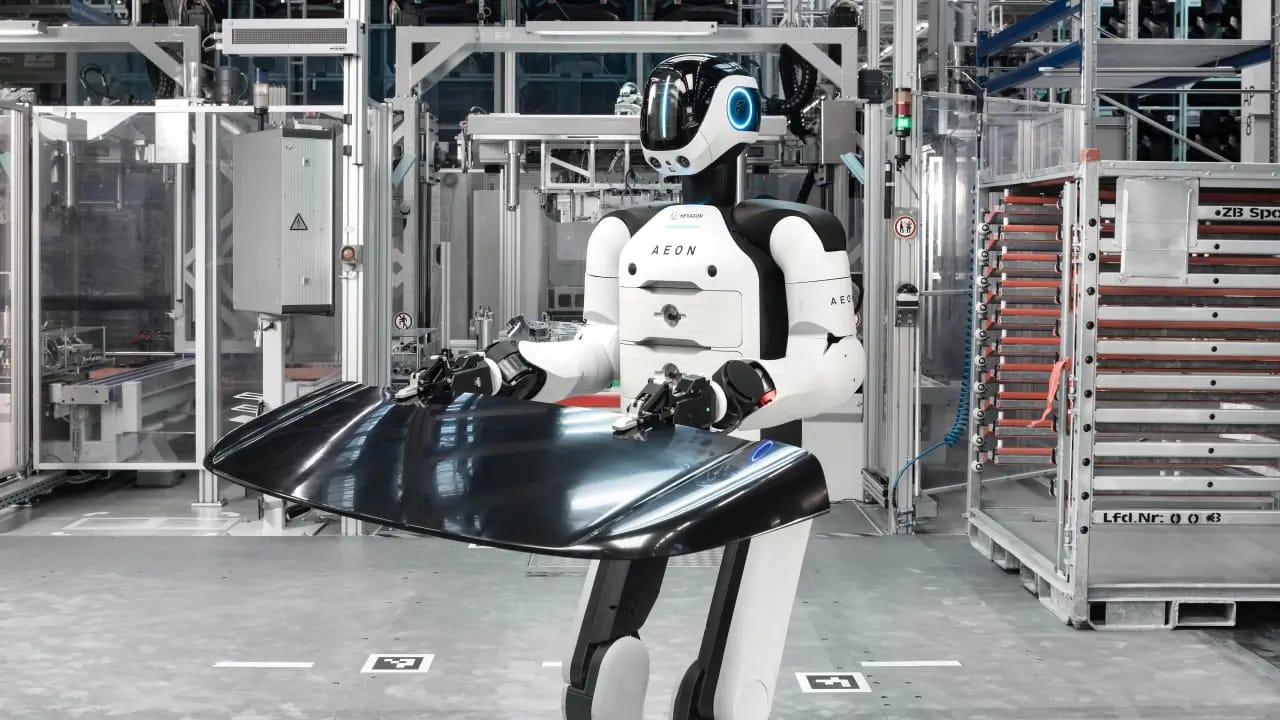
Image source: BMW
The Rundown: BMW is piloting Hexagon’s AEON wheeled humanoids on high-voltage battery and component workflows at its plant in Leipzig, Germany — marking BMW’s first humanoid-robot deployment in European production.
The details:
The move follows an 11-month Figure 02 pilot at BMW’s Spartanburg, SC plant, where robots logged 10-hour shifts and contributed to 30,000+ X3 builds.
The wheeled humanoids take on repetitive high-voltage battery and component tasks, swapping grippers, hands, and scanners as needed.
After lab tests and a December 2025 shop‑floor shakedown, BMW will scale up integration from April 2026, with a full series‑production pilot in summer 2026.
Meanwhile, Mercedes-Benz is testing Apptronik’s Apollo humanoids at its Digital Factory Campus in Berlin and also in Kecskemét, Hungary.
Why it matters: Humanoids that can survive messy, unionized German shop floors are very different from showroom demo bots — they have to hit cycle times, respect safety rules, and win over skeptical workers. If AEON clears that bar, it could become a blueprint for deploying humanoids across Europe’s most regulated factories.
LENOVO

Image source: Lenovo
The Rundown: Chinese tech giant Lenovo just unveiled a puppy‑eyed robot arm designed to sit on your desk as an always‑on AI coworker, watching you work while managing calls, notifications, and simple physical tasks.
The details:
Lenovo unveiled the AI Workmate prototype robotic desk companion at the Mobile World Congress in Barcelona.
The device pairs a compact robotic arm with an animated screen displaying wide, cartoon-like eyes that track the user and signal status.
Designed to sit beside a PC, it uses local AI to handle voice commands, manage calls and notifications, set timers, and control apps.
The arm can tap keys, point at content, and assist with basic physical gestures like document signing.
Why it matters: Lenovo’s AI Workmate arrives as tech giants race to turn ambient AI into hardware — Amazon has Astro, and Apple and OpenAI are also reportedly cooking up their own desk devices. But this always-on, watching prototype certainly raises the question: how much AI surveillance are we actually willing to invite onto our desks?
HONOR

Image source: Honor
The Rundown: Smartphone maker Honor used the Mobile World Congress in Barcelona to step out of the phone race and into “physical AI,” unveiling a dancing, backflipping humanoid after teasing the news last week.
The details:
The humanoid danced to Imagine Dragons’ “Believer,” moonwalked alongside human backup dancers, and shook hands with Honor’s CEO onstage.
The matte‑black humanoid features a light‑bar “face,” sleek curved panels, and smooth, human‑like joints.
Honor pitched the robot as a future consumer‑grade assistant for tasks like shopping help, workplace inspections, and basic companionship.
Honor’s new humanoid shared the stage with a “Robot Phone” that puts a small, moving robot in a handset shell.
Why it matters: Honor spent last week teasing a mysterious “one more thing,” then followed through with a full humanoid song‑and‑dance reveal at the MWC. It shows phone brands now see humanoids as the next premium hardware tier, using flashy demos to prime consumers for physical‑AI ecosystems.
QUICK HITS
Chicago banned autonomous sidewalk delivery robots after residents complained that the machines blocked walkways and raised safety and accessibility concerns.
Crypto-focused venture firm Paradigm is raising a new fund of up to $1.5B to expand beyond blockchain into investments in robotics and AI.
Elon Musk claimed Tesla is close to launching driverless robotaxis in California, but Reuters reports that the company logged zero autonomous test miles in 2025.
Tokyo Electric Power Company unveiled a snake-like robotic arm to navigate tight spaces inside the Fukushima Daiichi reactors to remove radioactive debris.
Chinese startup AgiBot launched a Qingtian Rent platform that lets customers hire robots for short gigs, with daily rates reaching about $14K for top-tier packages.
China rolled out its first national standard system for humanoids and embodied AI, turning kung‑fu showpieces into a regulated platform for real industrial work.
Xiaomi put its humanoid on real EV lines, saying they autonomously install self‑tapping nuts in the die‑casting shop on a 76‑second cycle with 90% success.
Physical AI data-infrastructure startup Encord raised $60M in a Series C round to scale its platform for training robots, drones, and other autonomous systems.
Researchers built a soft robotic wing with built‑in sensing that mimics marine animals, reshaping itself in currents to boost stability for autonomous vehicles.
COMMUNITY
Read our last AI newsletter: OpenAI steps into Anthropic’s Pentagon void
Read our last Tech newsletter: Netflix exits $83B Warner Bros. deal
Read our last Robotics newsletter: Unitree’s most powerful robot dog yet
Today’s AI tool guide: Use Claude Cowork + Obsidian to triple your output
RSVP to our next workshop on March 12: AI coding bootcamp pt. 1
That's it for today!Before you go we'd love to know what you thought of today's newsletter to help us improve The Rundown experience for you. |
See you soon,
Rowan, Joey, Zach, Shubham, and Jennifer — The Rundown’s editorial team