- The Rundown Robotics
- Posts
- Trump's next big move: robots
Trump's next big move: robots
PLUS: Bots made from lobster leftovers


Jennifer Mossalgue & Rowan Cheung
December 08, 2025

Good morning, robotics enthusiasts. Trump’s AI obsession just sprouted metallic limbs: Commerce Secretary Howard Lutnick is reportedly meeting CEOs from Boston Dynamics to Apptronik as the White House plans a 2026 push to pack U.S. factories with robots.
The twist? Reshore manufacturing and take on China — but let machines do the work.
In today’s robotics rundown:
White House readies 2026 robotics push
These bots are made from lobster shells
Robot builds furniture from speech
Robots hunt MH370 in new deep-sea search
Quick hits on other robotics news
LATEST DEVELOPMENTS
U.S. ROBOTICS

Image source: Ideogram / The Rundown
The Rundown: Trump spent 2025 pitching AI as a strategic asset; now he’s pivoting to robots. Politico says Commerce Secretary Howard Lutnick is courting robotics CEOs as the White House drafts a 2026 executive order to double down on robotics.
The details:
The Department of Transportation is also preparing a robotics working group, expected to be announced as part of a broader federal robotics effort.
Ideas on the table include tax breaks and federal funding for robotics firms and tougher trade measures aimed at Chinese subsidies and IP abuses.
By 2023, China was running about 1.8M industrial robots on its factory floors, roughly four times the U.S. total.
After Politico’s report dropped, robotics stocks jumped — pure-play names like Richtech Robotics and Serve Robotics surged.
Why it matters: Washington’s rumored shift from software to embodied AI acknowledges that data center computing alone won’t counter China's manufacturing edge. The administration now faces a political paradox: promising American jobs while banking on automation to compete globally.
EPFL
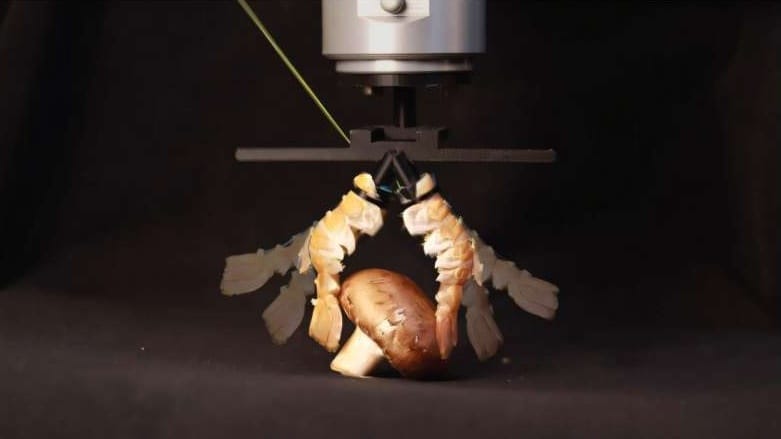
Image source: EPFL
The Rundown: Engineers at EPFL just turned lobster leftovers into working robot parts — by treating the shells as ready-made exoskeletons and making the case that tomorrow’s “biohybrids” might be built from yesterday’s dinner.
The details:
Researchers injected the shells with soft elastomer, added motors, and coated them in silicone to create durable, controllable biohybrid actuators.
These actuators can lift 500 grams solo or work as grippers that can handle everything from highlighter pens to fragile tomatoes.
The shells’ natural structure provides a built-in combo of strength and bendability that’s ideal for joints and grippers.
The researchers even demonstrated a swimming robot propelled by two flapping exoskeletal fins.
Why it matters: After use, most synthetic components from the lobster bot can be reused. The team calls it “dead matter robotics,” showing how food waste can be repurposed into low-cost, eco-friendly robot hardware — though natural variation in biological structures requires more sophisticated controllers for precision tasks.
MIT
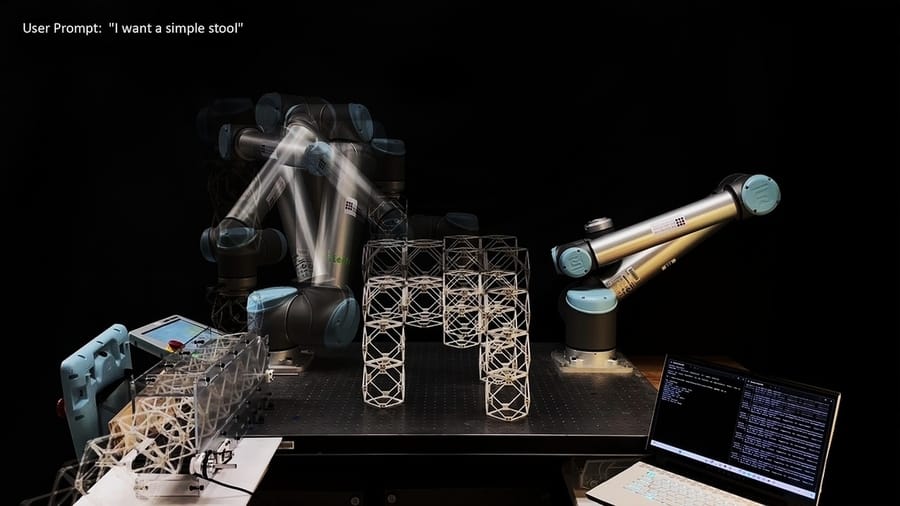
Image source: MIT
The Rundown: MIT researchers are closing the loop between generative AI and the physical world with a “speech‑to‑reality” system that lets you literally talk a robot through building furniture.
The details:
A table‑mounted robotic arm listens to spoken prompts like “build a simple stool with three legs” or “a low shelf.”
The system uses 3D generative models to design a structure that matches the request, and then snaps together modular beams, joints, and panels.
In demos, the setup managed to assemble stools, chairs, shelves, a small table, and even a dog statue in just a few minutes.
The team plans to swap magnetic connections for more robust joints to improve weight-bearing capability.
Why it matters: The modular approach could eliminate manufacturing waste by letting users disassemble and reconfigure components into entirely new objects when needs change. It also makes physical fabrication accessible to anyone who can describe what they want — no 3D modeling skills or robotics knowledge required.
OCEAN INFINITY

Image source: Ocean Infinity
The Rundown: Malaysia is now deploying a private robot fleet into the Indian Ocean for another crack at the MH370 mystery, more than a decade after the Boeing 777 vanished with 239 people aboard.
The details:
Malaysia’s transport ministry says Texas-based marine robotics firm Ocean Infinity will restart a deep-sea search for MH370 later this month.
The Malaysian government will pay Ocean Infinity a fee of $70M if its 18‑month search locates the wreckage.
Malaysia approved Ocean Infinity’s mission in March, but the search was suspended after bad weather hit a new 15K-square-km search area.
Ocean Infinity’s CEO says the firm has significantly upgraded its subsea tech since its unsuccessful 2018 search.
Why it matters: The search represents a high-stakes bet on autonomous underwater systems that have matured dramatically since 2018, when Ocean Infinity last tried and came up empty. Success would close aviation’s most confounding cold case while demonstrating how far deep-sea robotics has advanced in a few years.
QUICK HITS
Figure CEO Brett Adcock posted a short clip of the Figure 03 robot accelerating into a run, pivoting, and stopping cleanly, an answer to Tesla’s clip of Optimus running.
EngineAI’s founder, Zhao Tongyang, went viral after taking a brutal kick to the chest from the startup’s new T800 humanoid, a stunt meant to prove the robot’s power.
Boston Dynamics is hinting at a new update that, per Atlas lead Mario Bollini, would shift the Atlas from R&D to a humanoid built at “automotive” production volumes.
A new Unitree video shows its nearly 6-foot H2 humanoid fighting the smaller G1, recycling the kickboxing routines the company first trained on its shorter bots.
Waymo says it will file a voluntary software recall with federal safety regulators over how its robotaxis behave around school buses in response to NHTSA scrutiny.
Midea Group, one of the world’s largest home appliance makers, unveiled what it claims is the world’s first six‑armed humanoid.
Hyundai unveiled its four-wheeled MobED, a production-ready mobility bot aimed at last‑mile delivery, logistics, and other industrial jobs.
Israeli startup Mentee Robotics has broken its 2025 silence with an uncut 18-minute demo of two V3 MenteeBot humanoids autonomously running warehouse tasks.
Distalmotion raised $150M in funding that will primarily go toward ramping U.S. adoption of its Dexter soft‑tissue robotic surgery system.
A Baidu robotaxi in Zhuzhou, China, struck two pedestrians, trapping one under the vehicle and sending both to intensive care.
Malaysian agtech firm Agroz is teaming up with China’s UBTECH to drop Walker S humanoids into its vertical farms, where they’ll seed, monitor, and harvest crops.
UK researchers will employ robotic dogs, drones, and experimental 6G links in an EU-backed pilot in Greece to spot early wildfire signs and alert responders faster.
A humanoid dubbed Hangxing No. 1 is directing traffic, spotting violations, and issuing audio warnings at a major intersection in Hangzhou’s Binjiang district.
COMMUNITY
Read our last AI newsletter: Poetiq cracks major reasoning benchmark
Read our last Tech newsletter: Netflix buys Warner Bros. in $82B deal
Read our last Robotics newsletter: Humanoid breaks record for fastest build
Today’s AI tool guide: Create LinkedIn carousels in ChatGPT with Canva
Watch our last live workshop: Nano Banana For Slide Decks
That's it for today!Before you go we'd love to know what you thought of today's newsletter to help us improve The Rundown experience for you. |
See you soon,
Rowan, Jennifer, and Joey—The Rundown’s editorial team