- The Rundown Robotics
- Posts
- Cancer-fighting bubble bots
Cancer-fighting bubble bots
PLUS: Unitree's G1 rides a skateboard


Jennifer Mossalgue, Joey Liu, Rowan Cheung, Shubham Sharma & Zach Mink
February 05, 2026

Good morning, robotics enthusiasts. Caltech and USC researchers have turned tiny medical “bubbles” into steerable microbots that can deliver chemo right to a tumor.
They ride the body’s own chemistry, swarm the target, then pop on an ultrasound cue to release their payload. It’s a wild glimpse of a future where cancer treatment gets smarter, sharper, and a lot less brutal.
In today’s robotics rundown:
Bubble microbots blast tumors with drugs
A Unitree G1 humanoid rides a skateboard
Bedrock lands $270M for autonomous excavators
Carbon’s farm robots just got a lot smarter
Quick hits on other robotics news
LATEST DEVELOPMENTS
MICROBOTS

Image source: Gao Lab/Caltech
The Rundown: Caltech and USC researchers have transformed medical imaging bubbles into enzyme-powered microrobots that can be steered — or self-navigate — to tumors, then burst on cue to blast chemotherapy deep into cancerous tissue.
The details:
The enzyme-coated microbubbles act as simple, biocompatible microrobots capable of ferrying chemotherapy drugs directly to tumors.
The enzyme reacts with urea in bodily fluids to generate thrust, propelling the bubbles through tissue without onboard batteries or electronics.
Doctors can steer the bots externally with magnets or let them autonomously follow chemical gradients straight into tumors.
Once the swarm accumulates at the target site, a burst of ultrasound pops the bubbles and drives the drug deep into the tissue, not just across the surface.
Why it matters: These bubble bots demonstrate how microrobotics could make chemotherapy far more precise, hitting tumors while sparing healthy tissue. If the research advances, it joins a growing field of magnetic and ultrasound-guided microrobots racing to slash doses and side effects through targeted delivery.
HUMANOIDS

Image source: HUSKY Github
The Rundown: Chinese researchers just taught a compact Unitree G1 humanoid to ride a skateboard using a physics-aware control framework called HUSKY, short for Humanoid Skateboarding System via Physics-Aware Whole-Body Control.
The details:
HUSKY models how pushing generates forward motion and how leaning steers the board, using limited human motion data to give the robot skater-like timing.
The system breaks skateboarding into discrete phases (pushing, coasting, steering) while directly mapping the robot’s lean angle to board turn radius.
After simulation training, the behaviors were transferred to a physical G1, which can now skate repeatedly across different boards.
The team plans to add onboard vision so the robot can track the skateboard and terrain in real time. HUSKY has also been open-sourced.
Why it matters: HUSKY shows that relatively affordable humanoids can learn agile, contact-rich skills using physics-aware control instead of pure reinforcement learning, opening the door to far more dynamic work than walking or lifting. The implication: future off-the-shelf humanoids could simply download “sport-like” behaviors.
BEDROCK ROBOTICS
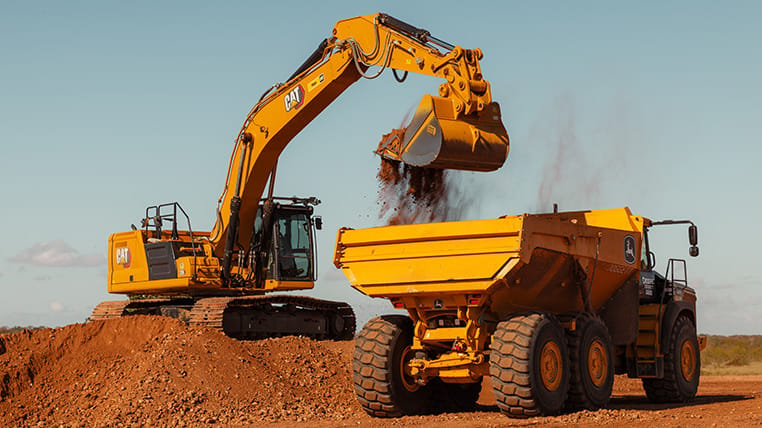
Image source: Bedrock Robotics
The Rundown: San Francisco–based startup Bedrock Robotics, founded by former Waymo and Segment engineers, raised $270M at a $1.75B valuation to scale its retrofit autonomy system for construction excavators.
The details:
The company raised $270M in Series B funding at a $1.75B valuation, bringing its total funding to more than $350M.
Bedrock’s Operator kit bolts lidar, GPS, IMUs, cameras, and in‑cab compute onto 20‑ to 80‑ton excavators so they can autonomously dig and load trucks.
The system has already moved more than 65K cubic yards of material autonomously on a 130-acre manufacturing site — an industry first.
Bedrock plans to graduate from single autonomous machines to coordinated fleets, with fully operator-less sites targeted for 2026.
Why it matters: The construction boom in data centers is colliding with a massive labor shortfall, and Bedrock is pitching its robo-excavator fleets as a way to keep projects moving. If it’s robots scale, they could normalize self-driving heavy equipment on mainstream sites, even as rivals Built Robotics and SafeAI race to do the same.
CARBON ROBOTICS

Image source: Carbon Robotics
The Rundown: Seattle-based Carbon Robotics, the maker of the laser-toting LaserWeeder farm robot, built a new foundation model for plants that it says can recognize virtually any species it encounters in the field.
The details:
Carbon Robotics unveiled its Large Plant Model (LPM), an AI foundation model that can instantly recognize and classify plant species for precision weeding.
The model was trained on more than 150M labeled images collected by Carbon’s robots across over 100 farms in 15 countries.
Previously, every new weed required fresh labeling and retraining, a process that took about 24 hours each time.
With LPM, farmers can now flag a new weed directly in the robot’s interface and instruct the machine to kill it immediately — no retraining required.
Why it matters: Carbon’s model makes robo-weeding far more flexible, letting growers zap new weeds on the fly while slashing reliance on chemical herbicides. If it scales, Carbon could strengthen the economics of laser weeding and give rivals like Blue River and FarmWise pressure to match both its autonomy and environmental credentials.
QUICK HITS
UK startup Humanoid announced KinetIQ, a “shared brain” AI framework that lets fleets of robots learn and coordinate tasks under one cloud-based control system.
China is training drones and robots on animal-inspired tactics — such as teaching them to hunt like hawks — to create more autonomous, battlefield-ready military robots.
LimX Dynamics, a Shenzhen-based humanoid startup, raised $200M in Series B funding to scale its full-size Oli humanoid and modular TRON robots.
New York Robotics launched as a non-profit group to unify the New York–New Jersey–Connecticut robotics ecosystem, which it says includes more than 160 startups.
Uber promoted Balaji Krishnamurthy to CFO as it doubles down on autonomous vehicles and aims to be the biggest platform for robotaxi trips by the decade’s end.
The UK’s Sellafield nuclear site tested a new swabbing tool mounted on a Boston Dynamics Spot robot to check for radioactive contamination.
Shanghai-based DroidUp unveiled Moya, a “biomimetic” humanoid that walks with 92% human-like gait accuracy and mimics micro‑expressions.
Duke engineers created Lego-like blocks with tunable stiffness so robots can switch between rigid and soft modes, changing how they move without being rebuilt.
Chinese researchers unveiled Bolt, a full-sized humanoid that can sprint at 10 meters per second, which they tout as the world’s fastest running robot.
Harvard engineers developed “rolling contact” joints that mimic human knees, allowing robots to correct misalignment by 99% and grippers to lift 3x more weight.
FedEx signed a multi-year deal with Berkshire Grey to deploy Scoop, a robotic trailer unloader designed to autonomously empty mixed-package trailers.
COMMUNITY
Read our last AI newsletter: Anthropic’s ad-free campaign
Read our last Tech newsletter: The race to make space babies
Read our last Robotics newsletter: Waymo hits record $110B valuation
Today’s AI tool guide: Set up a coordinated coding team with Codex App
RSVP to our next workshop on Feb. 11: Agentic Workflows Bootcamp pt. 1
That's it for today!Before you go we'd love to know what you thought of today's newsletter to help us improve The Rundown experience for you. |
See you soon,
Rowan, Joey, Zach, Shubham, and Jennifer — The Rundown’s editorial team