- The Rundown Robotics
- Posts
- Waymo hits record $110B valuation
Waymo hits record $110B valuation
PLUS: China's new-and-improved drone swarms


Jennifer Mossalgue, Joey Liu, Rowan Cheung, Shubham Sharma & Zach Mink
February 02, 2026

Good morning, robotics enthusiasts. Alphabet is reportedly fueling a mega-round that would price Waymo’s driverless ride-hailing service at $110B.
Waymo has already logged tens of millions of rides, with a fresh launch now in Miami. But with the NHTSA circling a recent incident involving a child, its next chapter hinges on one thing: scaling without collateral damage.
In today’s robotics rundown:
Waymo pulls ahead with $110B valuation
Chinese drone swarms with special powers
Physical Intelligence: $1B to teach robots everything
Gartner pops the humanoid bubble
Quick hits on other robotics news
LATEST DEVELOPMENTS
WAYMO
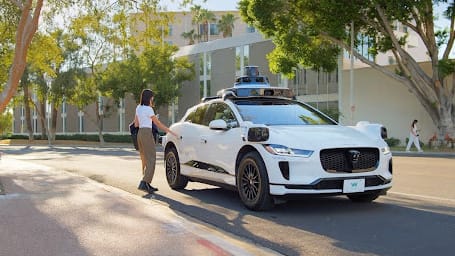
Image source: Waymo
The Rundown: Waymo just became the most valuable private company in transportation, with the Alphabet autonomous vehicle moonshot closing in on a $16B funding round at a record $110B valuation, reports the Financial Times.
The details:
Alphabet is providing more than three-fourths of the $16B, doubling down on its decade-long bet that self-driving cars will define the future of mobility.
The company has already surpassed 20M trips and recently launched public service in Miami, marking an aggressive geographic expansion.
Waymo now generates more than $350M in annual recurring revenue, and its valuation has more than doubled from its $45B Series C over a year ago.
However, last week, NHTSA opened an investigation after one of its rides struck a child near a Santa Monica school; the child sustained minor injuries.
Why it matters: A $110B valuation flags that investors now view robotaxis as a scaled transportation business, not just R&D, giving Waymo runway to expand fleet and geography. But safety investigations, recalls, and city-by-city laws are real constraints — and competitive pressure is rising from Tesla, Zoox, and Uber-backed Wayve.
DRONES

Image source: Ideogram / The Rundown
The Rundown: China’s People’s Liberation Army just showcased a 200-drone swarm where “intelligent algorithms” let units coordinate and keep operating even if the control link is jammed or lost, according to reports citing CCTV.
The details:
A single operator was shown controlling 200+ fixed-wing drones, shifting the human’s role from piloting individuals to directing effects.
Researchers said each drone runs an onboard “intelligent algorithm” and uses interconnection + autonomous negotiation to form formations and divide tasks.
The swarm is launched from a truck-based launcher system that can reportedly release 48 drones at once.
Russia and Ukraine have also turned drones into a core battlefield system, while the U.S. Army is moving toward fieldable “print-and-repair” drones.
Why it matters: A single operator directing 200 drones turns military control into “supervision at scale”: one person sets objectives while the swarm handles coordination and execution. Some U.S. defense startups are developing countermeasures, such as an AI anti-drone jet that can intercept them midair.
PHYSICAL INTELLIGENCE
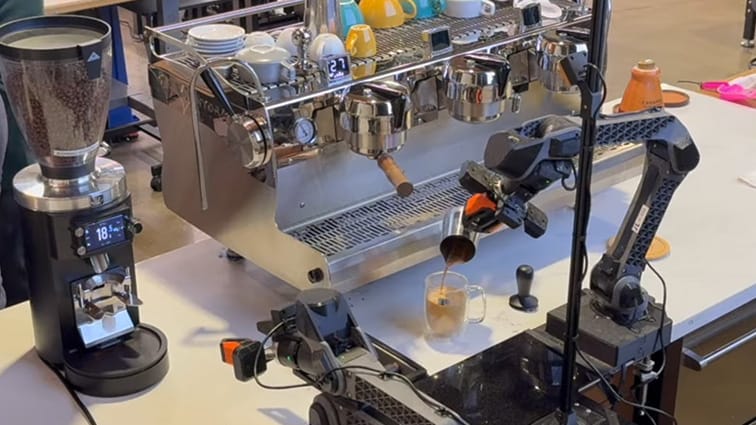
Image source: Physical Intelligence
The Rundown: Physical Intelligence, the two-year-old startup building “ChatGPT for robots,” has raised over $1B at a $5.6B valuation — and its co-founder, Lachy Groom, tells TechCrunch that he won’t give investors a timeline for making money.
The details:
Physical Intelligence is building general-purpose robotic foundation models trained on data from robot arms attempting real-world tasks.
Groom says most spending goes to compute, and “there’s no limit to how much money we can really put to work.”
The company open-sourced its flagship π0 model in 2025, a 3B-parameter system trained on over 10K hours of real-world robot data across 7 platforms.
Rival Skild AI has argued that players like Physical Intelligence rely too heavily on internet-scale pretraining rather than physics-based simulation and data.
Why it matters: The race to build general-purpose robotic intelligence is now drawing billion-dollar bets. Physical Intelligence is wagering that breakthroughs in fundamental research will translate into better AI, while rival Skild is betting that shipping products first will generate the real-world data that ultimately decides the winner.
HUMANOIDS

Image source: Ideogram / The Rundown
The Rundown: Gartner is throwing cold water on the humanoid hype: despite billions in funding flowing to Figure AI, Tesla, and Agility, the research firm predicts fewer than 20 companies will actually deploy humanoids in production by 2028.
The details:
Gartner adds that of the nearly 200 humanoid companies that exist today, fewer than 100 will progress to proofs of concept by 2028.
Most humanoid deployments will remain limited to “tightly controlled environments” rather than high-throughput operations like warehouses.
Gartner cited four key barriers: tech limitations in dexterity and adaptability, integration complexity with existing systems, high costs, and limited battery life.
Gartner argues that “polyfunctional” robots, such as wheeled platforms with robotics arms, deliver better throughput-per-dollar than humanoids.
Why it matters: Startups are pouring billions into chasing the humanoid dream, but Gartner’s verdict is blunt: the human form is more hype than operational edge, and multimodal bots will beat bipedal ones on ROI for years. Figure AI at BMW, Agility at Amazon, and Apptronik at Mercedes hope that they’ll prove the theory wrong.
QUICK HITS
Nvidia, Mercedes-Benz, and Uber are moving forward on a premium S-Class robotaxi powered by Nvidia’s Level 4 autonomous stack, but with no launch date yet.
Unitree’s G1 humanoid reportedly completed 130K+ steps across a -47.4°C snowfield in Xinjiang, making it the first autonomous humanoid walk in extreme cold.
Munich-based RobCo just banked a $100M Lightspeed-led Series C at a $500M valuation to turn its “physical AI” factory robots into a serious manufacturing player.
Starbucks is rolling out AI-driven order-capture and “Smart Queue” workflow automation — software robotics aimed at automating drive-thru ordering.
Xpeng’s Iron humanoid took a headline-grabbing tumble at its Shenzhen mall debut, but before that, it wowed crowds with a fluid, model-like gait and soft “skin.”
Waymo finally launched a robotaxi service to and from San Francisco International Airport, a critical win for the company’s business model.
NASA’s Perseverance rover completed its first AI-planned drive on Mars, using Anthropic models to chart and execute hundreds of meters of autonomous navigation.
Swiss research institute EMPA upgraded its FireDrone with a new polyimide aerogel insulation layer that can withstand 200°C (392°F) for up to 10 minutes.
A new review in npj Robotics says electronic noses for robots are rapidly improving through multi-sensor arrays and AI-powered odor-tracking algorithms.
U.S. researchers built a hydrogel “synthetic muscle” with microfluidic channels that speed fuel and signals, enabling faster, more precise soft robots and prosthetics.
Persona AI is partnering with Louisiana to pilot humanoids at an SSE Steel plant, testing “4D job” tasks like welding in factory conditions.
OpenMind launched an OM1-based app store that lets humanoid and quadruped robots download new skills so their capabilities can expand via software.
Dubai is staging a global challenge to deliver the world’s first fully robot-built villa, using a new ConTech hub and a “70-70” push toward offsite, automated construction.
Read our last AI newsletter: AI agents get their own social network
Read our last Tech newsletter: Humans head back to the moon
Read our last Robotics newsletter: Waabi nabs $1B in Uber robotaxi deal
Today’s AI tool guide: Claude Cowork for video clipping and editing
RSVP to our next workshop on Feb. 11: Agentic Workflows Bootcamp pt. 1
That's it for today!Before you go we'd love to know what you thought of today's newsletter to help us improve The Rundown experience for you. |
See you soon,
Rowan, Joey, Zach, Shubham, and Jennifer — The Rundown’s editorial team